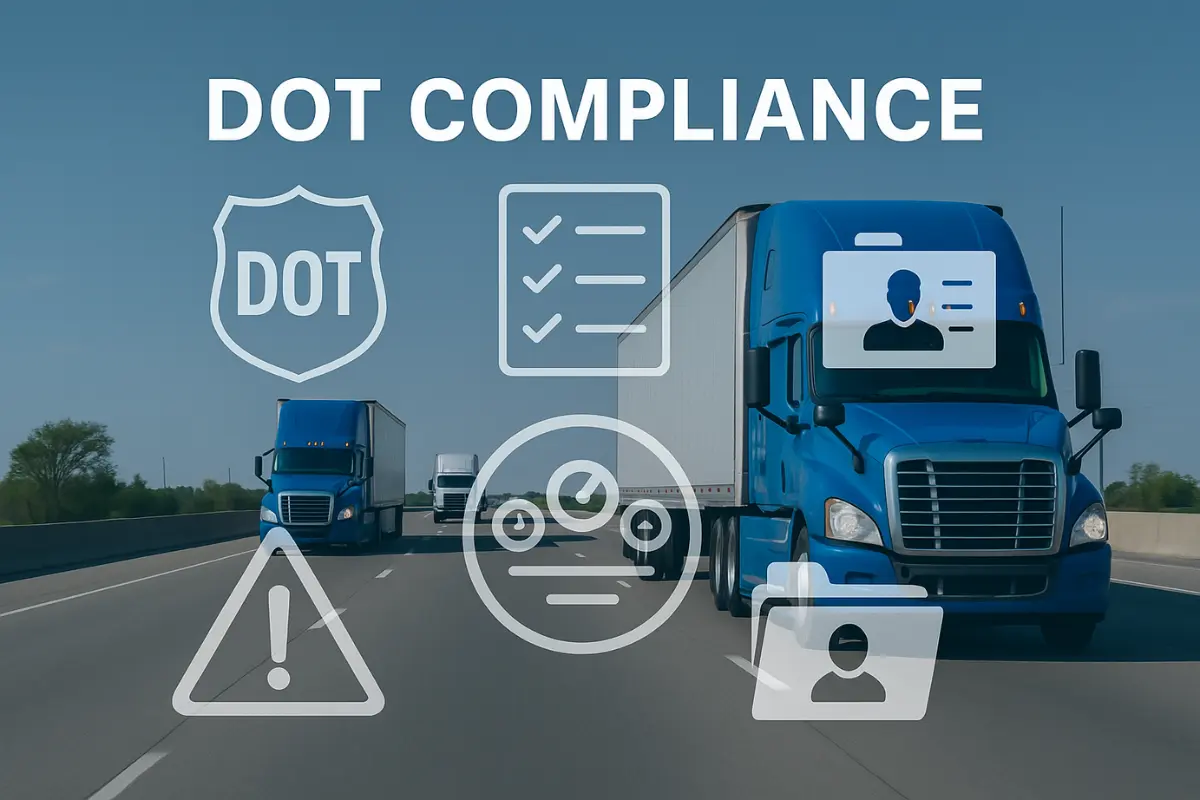
Fleet operations generally portray compliance as though it was a simple rulebook either allowing freedom or necessitating absolute rigidity. The fact is, compliance lives somewhere between those extremes — and misconstruing that line is one of the most prevalent reasons of violations, enforcement actions, and internal friction within fleets.
Fleet compliance is not about ensuring loopholes are left behind nor is it about automating regulations to the letter without having any idea on the intended outcomes. Fleet compliance is all about the understanding of which compliance rules are structurally non-negotiable under federal and state laws, and which decisions in turn can be redirected without breaking regulatory lines. Most compliance breaches do not occur because a fleet willingly set aside the rules. They happen because myths stealthily substitute facts in day-to-day fleet activities.
These compliance myths often grow inside organizations when assumptions replace verification and informal practices slowly turn into perceived standards. Over time, such regulatory myths shape internal behavior and distort the understanding of true regulatory compliance.
The article at hand will broach the most persistent myths related to compliance within contemporary fleets, provide reasons for their existence and clearly identify the negotiable operational practices and compliance standards that are non-negotiable. Only with this understanding can fleet managers, safety departments, and leadership teams ensure utmost safety and regulatory regulations for the long term.
Reasons For The Persistence of Compliance Myths Inside Fleet Operations

Compliance myths are usually associated mainly with environments where experience is not matched with verification. Fleet runs for years without major incidents, feel like routine check-ups since they are so common and enforce-ments irregular. Over the years informal rules come to take the place of written regulations.
Statements like “this one inspector is cool with it,” “we’ve never been cited for that,” or “anyway other fleets do that” collectively deform the internal unique compliance culture. These beliefs are furthermore supported by the operational pressure — fast vehicles, the dearth of drivers, unsatisfied customers, and cost control.
Such narratives slowly evolve into fleet negotiation habits, where teams believe they are informally negotiating compliance rather than adhering to fixed rules defined by law.
Fleet laws, however, are neither established on previous cases nor on convenience. They derive from federal laws, are sustained by state legal frameworks, and are upheld through unbiased inspection and audit systems. Even if enforcement discretion may differ in various cases, compliance standards remain the same.
This distinction is central to understanding regulatory compliance in trucking operations. Variability in enforcement does not equal flexibility in the law. When fleets misinterpret enforcement variability as regulatory flexibility, myths start leading their decision-making. As time goes by, these myths develop into systemic compliance errors.
What Is an ELD? Truckers MUST Know This to Stay Legal in 2025!
Why Compliance Myths Take Root in Fleets
| Source of Myth | How It Develops | Long-Term Risk |
| Informal experience | Past inspections without citations | False sense of legality |
| Operational pressure | Tight schedules and staffing gaps | Systemic rule bending |
| Inconsistent enforcement | Different inspectors, same rules | Misread regulatory intent |
| Poor verification | Lack of audits or reviews | Hidden violations |
| Cultural habits | “We’ve always done it this way” | Institutionalized non-compliance |
The Most Dangerous Myth: “Compliance Is Flexible If It Doesn’t Compromise Safety”
The most widespread idols of fleet operations assume that compliance can be overshadowed by everything being safe. This sounds reasonable but misses the precise point of how compliance with regulations works.
DOT compliance is not determined by the motives, it is assessed by the existing documentation, consistency, and measurable limits. To illustrate, a driver may feel they acted safely by driving longer hours to a familiar place, delaying maintenance because the vehicle “felt fine,” or editing logs later to match memory. Nevertheless, from a regulatory perspective, those actions are still violations if they fall outside compliance rules.
Safety regulations are designed to eliminate subjective interpretation. They exist specifically to remove decision-making from moments of pressure, fatigue, or urgency.
Safety assessments should be made within compliance frames. If not, the frame inspector will take them as unauthorized actions even if the person has a motive in their mind. That is why compliance rules are seen as non-negotiable compliance, even when safety feels subjectively improved.
This myth continues to exist mainly because it is based on logic. However, logic cannot be a substitute for regulation.
Why Hours of Service Are Not a Tool for Negotiation

The Hours of Service rule is one of the most granted examples of the absolute lack of negotiable compliance that falls under. As a matter of fact, HOS rules are often one of the most frequently “negotiated” areas.
Managers in a fleet may feel that they must deliver the load on time. Drivers, on the other hand, may consider adding an hour to their driving time as a safe option by avoiding an un-safe stop. A dispatcher might think that it is a matter of experience that gives the permission to operate differently. However, none of these pressures alter how the HOS rule is structured.
HOS rules are part of broader trucking regulations and exist to standardize fatigue management across all fleets, regardless of size or operational model.
Daily limits, on-duty accumulation, mandatory breaks, and weekly caps are quite definitely the direct result of federal regulations. Though exceptions can occur, they are usually just that – specific, narrow, and conditional. Additionally, they are not negotiable or scalable based on operational requirements.
Negotiating HOS rules – even in informal settings – is the basis for the systemic risk. After a fleet operating HOS rules as flexible instead of strict, problems with driver logs results, violations stack up and intrusive measures of regulatory actions will ensue consequently.
Non-Negotiable Compliance Areas in Fleet Operations
| Compliance Area | Why It Cannot Be Negotiated | Typical Misconception |
| Hours of Service | Federally fixed fatigue limits | “One extra hour is safer” |
| ELD mandate | Data accuracy requirement | “Device installed = compliant” |
| Driver qualification | Continuous legal obligation | “Checked at hiring only” |
| Vehicle safety standards | Objective inspection criteria | “Truck still feels fine” |
| DOT documentation | Legal proof of compliance | “Explained verbally” |
The ELD Mandate Myth: “It’s Just the Device, Not the Data”
Another widespread incident of non-compliance is setting up a myth that ELD compliance is just about installing logging devices and period. Much to the contrary, the primary intent behind the ELD mandate is to make sure that the driver logs are both accurate and consistent, rather than the mere presence of technological interventions.
Inspections are not conducted by the mere act of installing hardware. The inspectors search for unassigned driving, late edits, wrong duty status changes, missing annotations, and data mismatches. The device is said to only record that which the drivers agree with and not what actually happened.
Failures in this area often expose deeper weaknesses in fleet safety systems and internal oversight.
The youth of this myth frequently gets fleets to expend less on the log review processes, driver training, and auditing the internal process. The inspections will later come and show the gap between the recorded data and what has happened in reality.
ELD compliance is all about behavior, it’s about teamwork, not just equipment.
Trucking Myths vs. Reality: What Fleet Owners Need to Know
Where Fleet Negotiation Actually Exists

Not every dimension of fleet compliance is hermetically sealed, even though federal regulatory laws set the pace. The bottom line is recognizing the area where operational discretion is found, and where it’s definitely not.
Negotiation does not entail breaking rules, it is a matter of structuring the processes to operate successfully under them. Proper fleet negotiation focuses on systems, not exemptions.
Internal Compliance Policy: Structure Is Flexible, Standards Are Not
The main flexibility fleet managers have at their disposal is in choosing how they create internal compliance policies. They can decide how often logs are reviewed, the manner in which training is conducted, how the maintenance is scheduled, and how compliance performance which is assessed internally.
A fleet can implement stricter internal standards, such as conducting more frequent audits, shorter maintenance intervals, or additional driver training. What it cannot do is to set standards that reduce compliance below the regulatory minimums.
Strong compliance policy supports long-term regulatory compliance and reduces exposure during audits. The internal compliance policy varies as to the structure but remains firm in substance.
Vehicle Maintenance: Strategy vs Standards
Vehicle maintenance more often than not is confused with an area of flexibility. The truth remains the same, without a doubt, the standards are fixed while the strategy adjustable.
Vehicle maintenance requirements are embedded in safety regulations and enforced uniformly across fleets.
Brakes must brake. Lights must light. Safety-critical components must meet the inspection criteria. These results are not negotiable.
What the fleets can negotiate is how they achieve compliance —whether through preventive maintenance schedules, mobile service units, in-house shops, or third-party vendors. The outcome must always meet compliance standards, irrespective of the method.
This distinction becomes essential. Fleets that muddle strategy with standards routinely see maintenance compliance until the inspection turns it down.
Negotiable vs Non-Negotiable Elements in Fleet Compliance
| Category | Negotiable | Non-Negotiable |
| Internal audits | Frequency, format | Existence |
| Driver training | Method, schedule | Qualification validity |
| Maintenance planning | Strategy, vendors | Safety standards |
| Routing | Planning options | Legal restrictions |
| Compliance culture | Internal approach | Federal regulations |
State Compliance Does Not Replace Federal Law
Multi-state fleet operations mainly encounter misunderstandings coupled with state compliance against federal regulations. While states could impose additional requirements they cannot cancel out any federal standards.
Fleet laws at the federal level always take precedence, and state compliance operates on top of that baseline.
Conditions in a state could force tighter rules or add to existing ones but they cannot, deprive people of rights under the rules of the federal law. Fleets which rely on the supposed notion of state leniency are often confronted with reality during federal audits or cross-state inspections.Federally mandated compliance will always be the starting point.
Driver Qualification Is an Ongoing Obligation, Not an Event
Driver qualification is commonly dealt with as a one-time onboarding procedure. This assumption quietly creates long-term compliance exposure.
Driver qualification is one of the most overlooked non-negotiable compliance areas in fleet operations. Medical certificates expire. License statuses change. The conditions differ. Driver qualification needs to be continuously checked and is not taken for granted.
Inspectors are increasingly defining driver qualification as a system-level obligation. A single lapse may reflect badly on the entire fleet’s compliance culture.
There are no-negotiable terms here, only maintenance.
Operational Routing: Flexible Decisions Within Fixed Rules
Routing decisions are in fact one of the few areas where operational flexibility exists fending off the need to comply. Fleets may prioritize routes based on efficiency, safety, or customer demands.
Conversely, the routing flexibility does not override the following:
- HOS limits
- Oversized permit restrictions
- Hazardous materials regulations
- State-specific route limitations
What’s negotiable is planning but not permission.
The Myth That Compliance Errors Are Only Drivers’ Problems
One of the most damaging myths is the belief that errors in compliance are just driver errors. State forms and the newer approach to freights views compliance as a responsibility of the fleet as a whole.
Many compliance errors originate at the system level rather than the driver level.
The pressure to schedule unclear policies, insufficient training, and poor communication lies most frequently on the fleet level. Drivers work inside systems created by management.
Negotiating compliance solely as a driver’s issue creates unaddressed systemic errors.
Recognizing the Real Boundary of Compliance
The actual point of differentiation in fleet compliance is not between strict and flexible but between regulatory requirements and operational choices.
Federal laws regarding safety, DOT compliance rules, HOS rules, ELD mandates, vehicle safety criterion, and driver qualification standards cannot be negotiated.
Methods for training, internal audits, maintenance strategies, routing plans, and compliance culture may be negotiable but only if they support instead of interfere with the compliance with the regulation.
Understanding this boundary is the foundation of compliance best practices.
Compliance Best Practices That Work
Effective fleets take a predictable style rather than improvisation. They invest in routine documentation, preemptive audits, lucid communication, and realistic scheduling.
Such compliance best practices strengthen fleet safety and reduce long-term risk.
Compliance best practices are not meant to avoid inspectors. They are simply made to eliminate surprises.
Final Perspective: Stop Negotiating with the Rulebook

The most flexible fleets shape operation so that it fits the compliance rules instead of debating them.
Compliance myths are the seeds of instability. But when one is crystal clear, they exhibit the highest degree of control.
Fleet operations are tough enough already, without gambling on regulatory assumptions. What is essential is to know what cannot be negotiated and where true flexibility is. This is the dividing line between compliant fleets and vulnerable ones.
Compliance is not an impediment to efficiency. It is the frame of reference that makes fleet operations sustainable, defendable, and safe.
No responses yet