Trucking, in compliance, is seldom lost because of a single major transgression. Most of the time, it goes unnoticed in the form of missed records, inconsistent documentations, outdated policies, or mismatches between the operational reality and the expectations of the regulators in writing. As the fleets increase and regulations change, compliance discipline is being viewed less as something that is contingent on people and more as something that is determined by machinery, or systems.
The compliance applications and documentation services have now been the bedrock of fleet operation. They do not take responsibility or make decisions; they assure consistency, audit readiness and traceability. For the trucking industry that deals with the DOT, safety regulations, and internal controls, the suitable compliance tools can be the distinction between routine inspections and disruption in operations.
This article will answer the main questions. What are the most commonly used categories of compliance software and services by trucking companies? How do the software and services support the regulatory requirements? If technology is the answer, to what extent it gets involved in building sustainable compliance discipline?
Factors to Consider While Applying Tech for Compliance in Trucking
Trucking adherence to the compliance requirements is heavily documented. Hours of daily logs, driver qualification files, maintenance records, inspection reports, policies, and training documentation all need to correspond — and be available during inspection with requisite.
Manual processes bear strain from:
- High driver turnover
- Distributed terminals and operations
- Frequent regulatory changes
- Audit and inspection pressure
Common Sources of Compliance Breakdown in Trucking
| Operational Factor | Impact on Compliance Discipline |
| High driver turnover | Incomplete or outdated driver qualification files |
| Distributed operations | Inconsistent record storage and documentation gaps |
| Regulatory changes | Policies and procedures becoming outdated |
| Audit pressure | Reactive corrections instead of continuous compliance |
Compliance discipline tools impart structure and order into where there were previously only informal habits. They install repeatability, standardize the process of record keeping, and lessen the use of memory and interpretations made by individuals.
In this case, the regulatory compliance software is a source of stability that does not add to the burdens of administration.
The Function of Compliance Discipline Tools in Fleet Operations

Transportation companies are experiencing a growing trend of complication; compliance discipline tools are at the core, linking daily activities with regulations expectations. These instruments do not function in solitariness; but make a compliance program that is the basis of documentation, monitoring, and accountability across the fleet.
The compliance solutions available today assist carriers in adopting a transition from reactive measures to proactive control. Through this, things would change, managers no longer have to be responding to violations after the fact, but they could be able to identify weak points in advance and correct them on the basis of data and documented proofs.
Compliance Management Platforms: The Core Layer
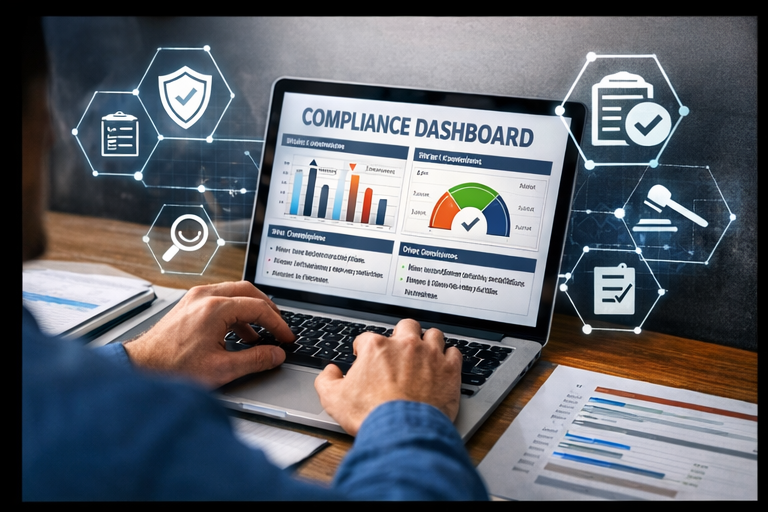
The compliance management platform is the foundation of the bulk of contemporary compliance systems. These tools bring together several compliance functions within the same user interface.
Typical features include:
- Cross-department compliance tracking
- Centralized documentation management
- Audit readiness dashboards
- Policy acknowledgment and version control
- Risk assessment and internal controls
Core Capabilities of Compliance Management Platforms
| Platform Capability | Operational Purpose |
| Centralized documentation | Single source of truth for audits |
| Compliance tracking | Visibility across departments and locations |
| Audit dashboards | Continuous audit readiness |
| Policy version control | Prevention of outdated procedures |
| Risk assessment tools | Early identification of compliance exposure |
For these reasons, trucking fleets gain a different perspective on compliance from seeing it as a system outside of a checklist view. Managers can now track variable changes early and take decision making through documentation before it soars the matter.
Governance, risk, and compliance (GRC) software applies to this category often, particularly in respect to the mid-size and big carriers.
Documentation Management and Digital Record Keeping
The BEST DOT Trucking Compliance Software (Demo) | DOT-Ready
Documentation services form the essence of the audit defense. Regulators don’t audit the will — they audit the records.
Digital documentation software is centered on:
- Secured storage of compliance records
- Version-controlled policy management
- Searchable documentation archives
- Retention rules aligned with regulatory requirements
The features that documentation management software has in trucking are:
- Driver qualification files
- Maintenance and inspection records
- Training certifications
- Incident and corrective action reports
The digital documentation through its decentralization avoids the loss of records, inconsistent storage formats, and the panic before the inspections.
Compliance Applications for Driver and Safety Records
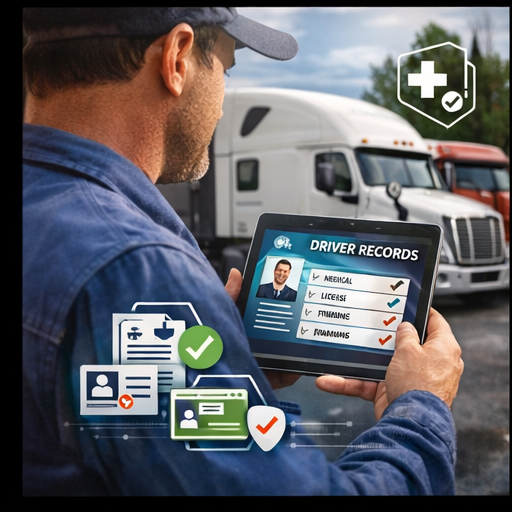
Driver compliance remains one of the most observed in trucking. The specialized applications for driver compliance help in maintaining accuracy and completeness.
Some common capabilities include:
- Driver qualification tracking
- Medical certification monitoring
- Training and policy acknowledgments
- Automated alerts for expiring documents
These compliance tools substitute spreadsheets or paper files for inventory units and assist fleets to keep the status permanently instead of reactively cleaning up.
Verification and Compliance Tracking Tools
The Mechanics of a DOT Audit (and Practical Tips for Surviving One)
Audit readiness is the perpetuation of a process that does not stop. The mind-set of compliance tracking tools exudes this by monitoring continuously the gaps that exist.
This verification-first approach mirrors how inspections are conducted in practice. According to the Commercial Vehicle Safety Alliance (CVSA), roadside inspections are structured into defined levels that systematically verify driver credentials, hours of service records, and vehicle condition. Inspectors rely on documented evidence rather than explanations, which reinforces the importance of continuous compliance tracking and audit readiness – https://cvsa.org/inspections/all-inspection-levels/
The main functions entail:
- Compliance scorecards
- Exception reporting
- Internal audit scheduling
- Evidence collection and linkage
Compliance Tracking Tools and Their Audit Role
| Tool Function | Contribution to Audit Readiness |
| Compliance scorecards | Ongoing visibility into compliance health |
| Exception reporting | Early detection of violations |
| Internal audits | Continuous preparation for inspections |
| Evidence linkage | Faster response during DOT audits |
In the presence of audits treated in the guise of regular operation, both the fleet’s confidence and outcome are uplifted.
Besides, audit readiness instruments have additional benefits for companies with multi-state activities or those that are often subjected to roadside checks and DOT inspections.
Policy Management and Internal Controls Software
Policies are only effective if they are current, acknowledged, and enforceable. The purpose of policy management tools is to structure what is, in many cases, a neglected compliance area.
These services support:
- Policy creation and approval workflows
- Digital acknowledgments by drivers and staff
- Policy version history
- Alignment with regulatory technology (RegTech) updates
Internal controls software complements this by documenting how policies are enforced, reviewed, and audited internally.
Individualization is the combination of these two tools, which strengthen the expected discipline that the regulatory authorities require to see.
Governance, Risk, and Compliance as Integrated Systems
For the expanded and developing fleets, compliance is being increasingly addressed through the governance risk compliance framework pathway as opposed to utilizing standalone tools. This is where the GRC software comes into play. It amalgamates compliance oversight, internal controls, and enterprise-wide visibility.
In such frameworks, risk assessment is not just a one-time practice but also a continuous risk management operation. This means that the fleet can regularly evaluate the impact of different circumstances such as changing drivers, routes, regulations, or implementing new documentation practices on its overall risk exposure.
This integrative approach assures that compliance disciplinary action is not merely a fragmented process but one that is uniform across both departments and locations.
Compliance Automation and RegTech Solutions
Regulatory Automation, or RegTech, connotes the technology that automates the routine compliance tasks that were done manually and were prone to error.
In trucking, RegTech automation most of the times targets:
- Regulatory change monitoring
- Automated compliance alerts
- Data validation across systems
- Reporting for inspections and audits
Automation is a tool that consent and responsibility are not diminishing but, rather, lessen friction and errors thus making compliance more consistent.
For the fleets, RegTech solutions are nothing more than the alert systems that spot the defects before they happen, even if it is under the never-ending regulatory pressure.
Data Security and Risk Assessment in Compliance Systems

Compliance records are no doubt sensitive. The driver information, inspection results, and the internal audit findings have to be secured as they must not leak out.
The platforms of modern compliance are made up of:
- Controlled access based on specific roles
- Data encryption and secure storage
- Document change audit trails
- Risk assessment modules
Data security now has no distance from compliance at all. More and more regulators are demanding operators demonstrate control over the information risk as well as hand risks.
Choosing the Most Appropriate Compliance Tools for Trucking
There is no one-size-fits-all compliance solution for every fleet. The right combination of tools relies on the size, complexity, and risk factors.
Finding the best compliance applications and services, fleets need to look at:
- How well they integrate with the existing systems
- If scalability comes as their operations grow
- User-friendliness for drivers and the staff
- If audit readiness features are there
- Support for trucking-specific regulations
The point is not the maximum technology, but adherent, reproducible compliance.
Technology as a Support System, Not a Shortcut
Compliance software documentation and applications do not create compliance on their own. They support behavior, reinforce discipline, and make expectations visible.
Fleets that rely on tools without accountability fail audits. Fleets that rely on people without systems eventually lose consistency.
The most resilient trucking operations use compliance tools as guardrails — not replacements — for professional judgment.
Automation, Data Security, and Long-Term Compliance Stability
The digitization of fleet records and workflows not only gives rise to issues with data security but also makes compliance. Thus, protecting the drivers files, audit records, and inspection data has now become a primary regulatory requirement instead of a secondary concern for the IT department.
Compliance automation, on the other hand, is the means of diverting human mistakes by the standardization of alerts, checklists, and reports. Automation ensures the right discipline by making sure that compliance tasks are done regularly, even during operational stress.
The combination of automated systems and securely handling data cultivates trust, not just in regulators but also in insurers, banks, and business partners.
Final Thoughts: Compliance Discipline Is Built, Not Installed
In trucking, the compliance failures are usually not dramatic. They usually stack up small gaps, document decisions that are not clear, and have processes that are outdated.
The best compliance apps, documentation services, and regulatory compliance software offer the framework that growth and complexity would ordinarily turn into a risk. They facilitate governance, bolster internal controls, and make audit readiness a standard condition instead of an emergency response.
At the end of the day, compliance discipline is a culture, but in modern trucking, it is a culture that is maintained through systems. In practice, this culture is reinforced by a compliance platform that connects documentation, controls, and oversight into a single, dependable operational structure.
No responses yet