
It is not a driver forgetting the rules of the road that mostly leads to failure of DOT inspection. Inspectors do not have time to read between the lines; they verify data. The most frequent cause of failure is the lack of information, or incomplete, impossible to validate the information on the spot. Hence, the design of an organized DOT inspection template for drivers and clear documentation of DOT authorities is a key factor in St. roadside inspection readiness.
For professional truck drivers and fleets, the templates are not just paperwork; they offer practical help. They are the operational tools that alleviate stress, save the time of the inspectors, and most importantly, prevent the risks of DOT violations. The ordered documentation facilitates the visible compliance of the legal provisions and this visibility is the crucial aspect that the auditors usually check first.
This article describes the most efficient document and record templates that simplify DOT inspection, indicates their relevant alignment with FMCSA documentation requirements, and demonstrates how they support different CVSA inspection levels ranging from driver-only inspection to level one inspection.
DOT documentation is one side of compliance — your personal record is the other. This explains commercial driver records, why they matter, and how to access them.
Importance of Templates in DOT Inspections
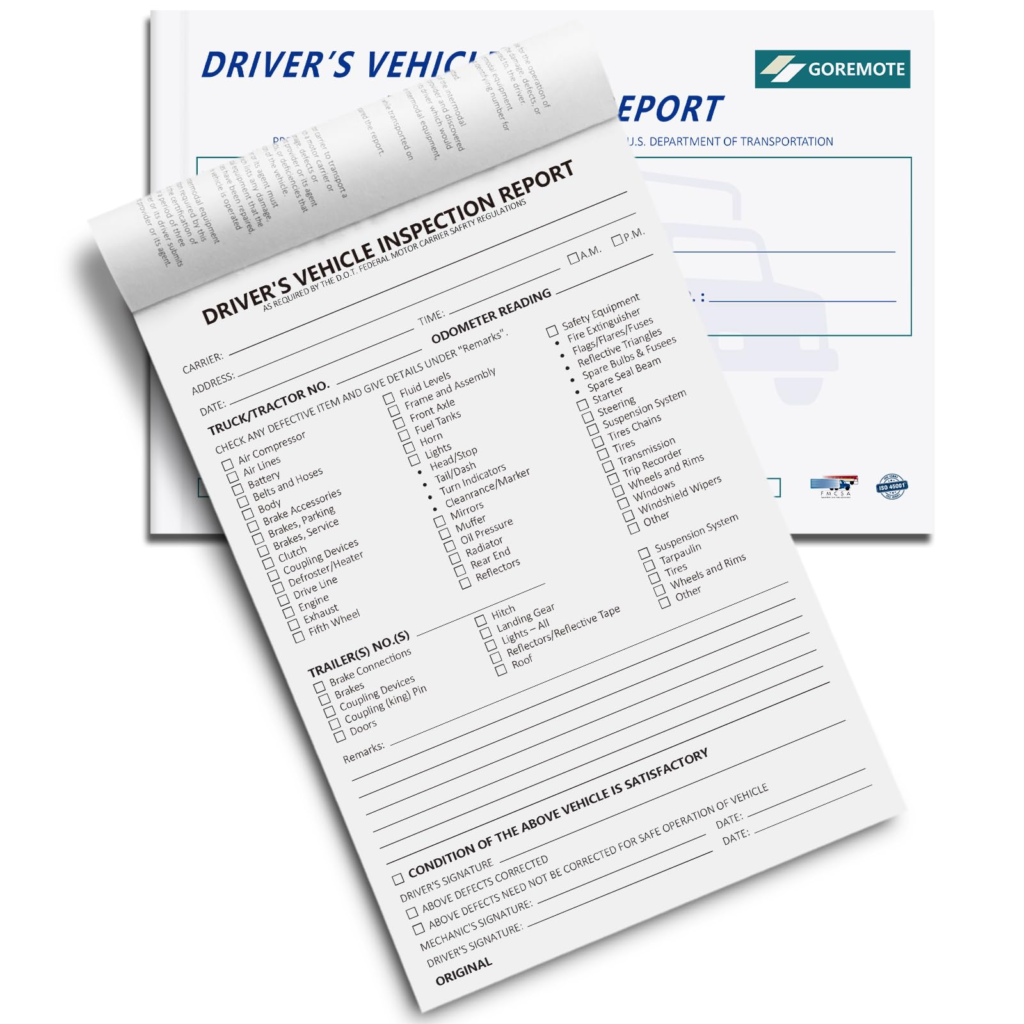
A DOT inspection is not a separate process; it is a small part of the ongoing compliance system static at that moment. Inspectors evaluate if safety and recordkeeping are integrated habits of work daily, or if they are seen as a last-minute emergency only.
Templates help in that they:
- Standardize data across vehicles and drivers
- Decrease opportunities for missing or conflicting data
- Facilitates faster document presentation during the inspection
- Support long-term DOT compliance
In reality, a driver using clear templates often goes through a straightforward commercial vehicle inspection even when inspectors choose to go deeper.
How Templates Improve DOT Inspection Outcomes
| Without Templates | With Templates |
| Documents shown randomly | Documents presented in expected order |
| Missing signatures or dates | Complete and consistent records |
| Longer inspection time | Faster verification |
| Higher violation risk | Lower compliance exposure |
Becoming Familiar with the Scope and Levels of a DOT Inspection
Before going through templates, it is more appropriate to know what is to be included in the check. CVSA inspection levels set the perimeter:
- Driver-only inspection stresses on the documents of the driver, logs, and weekly duty hours
- Vehicle-only inspection deals with the mechanical and safety systems of the vehicle
- Level 1 inspection is a mix driver and environment
- Other levels focus but still rely on paperwork
According to the Commercial Vehicle Safety Alliance (CVSA), Level 1 inspections include examination of the driver’s license, hours of service logs, brake systems, lighting devices, and other critical safety components. (Source: cvsa.org)
Each level is a piece of the same record and that is why templates must be entire, not broken.
FULL Level 1 DOT Inspection (Step by Step Guide Truckers NEED to See)
Template 1: Truck Inspection Checklist (Pre-Trip and Post-Trip)
The road to inspection readiness begins with a clear truck inspection checklist. This template is useful for both pre-trip inspection and post-trip reporting.
A comprehensive checklist template contains:
- Necessity for vehicle identification
- Move-around section
- Checkboxes for systems that need checks
- Space for defect notes/signatures
This entry is in direct correlation as it addresses the driver vehicle inspection rules, while consistency is proven during truck safety inspection checks.
Why it simplifies DOT inspection:
A standardized checklist demonstrates transparency. The inspectors want to see that inspections are a common thing, not one-time activities. A checklist proves that the driver uses the same process and checklist every day.
DOT Commercial Motor Vehicle Inspections Training
Template 2: Vehicle Inspection Form for Mechanical Systems

Apart from the pre-trip checklist, the vehicle inspection form is focused on the essential mechanical systems, like the brake, steering, suspension, tires, hoses, and leaks section.
Important parts typically consist of:
- Inspection of the brake system
- Steering and suspension
- Condition of tire and wheel
- Fluid leaks and hoses
The inclusion of air brakes is vital for level 1 inspected vehicles, as this is where the brake condition is closely observed.
Why it simplifies DOT inspection:
The clear division of mechanical inspections allays the need for the inspector to sift through unrelated documents in order to ascertain that the safety-critical systems are properly verified.
Mechanical Systems Inspectors Focus on During DOT Checks
| Vehicle System | Why It Matters |
| Brake system | Primary stopping safety |
| Air brake components | Required for Level 1 inspections |
| Tires and wheels | Load handling and road contact |
| Steering and suspension | Vehicle control |
| Hoses and leaks | Fire and failure risk |
Template 3: Lighting Devices Check Template
Lighting deviations are one of the most frequently noticed violations by DOT inspectors. A lighting devices check template dedicated for lighting can eliminate this risk.
The template usually suggests:
- Headlights and high beams
- Brake lights and turn signals
- Marker and clearance lights
- Reflectors and emergency lighting
When attached to daily inspection records it shows preemptive measure taken to address “visibility” which is one of the primary issues concerning roadside inspection readiness.
Template 4: Hours of Service Logs (ELD and Manual Records)
A correct hormonal log is essential for almost every DOT check. Even drivers with ELDs have to know the way and help a pull-log.
An efficient HOS template consists of:
- Short daily recaps that are plain
- Notes for different circumstances
- Reference dispatch or trip records
This helps the inspector quickly affirm compliance unmarred by undue protracted questioning.
Why it simplifies DOT inspection:
When logs are perfectly neat and annotated appropriately, errors that the inspector might find are less.
Template 5: Maintenance Records Log
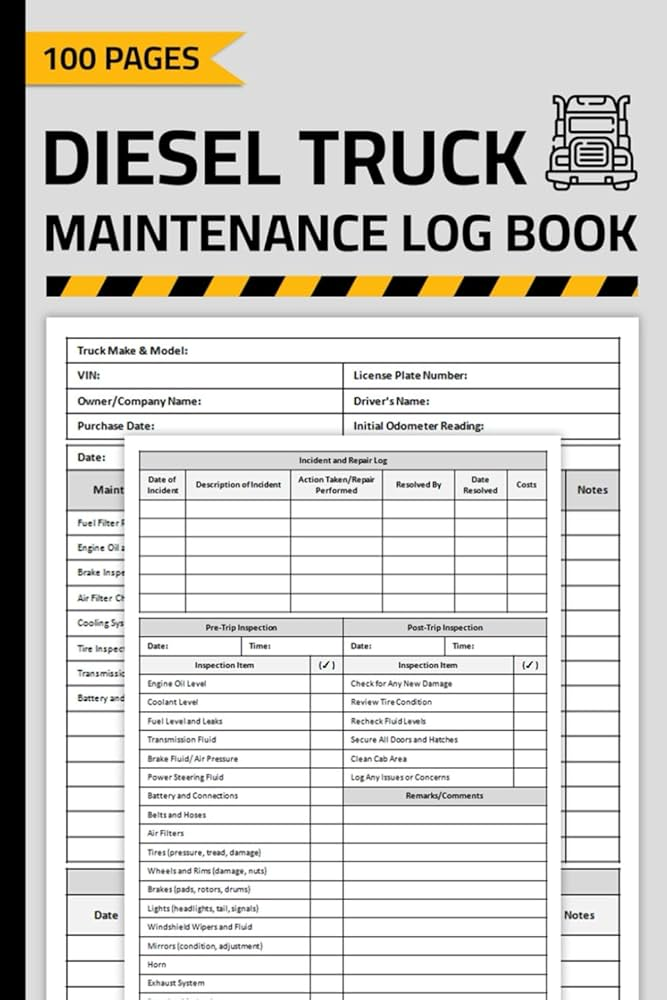
Many violations do not arise from current defects, but rather from the absence of a repair history. Updated maintenance records are a clear testament to the long-run responsibility of the company.
The maintenance template has a log of:
- Date of service
- Nature of repair or inspection
- Parts replaced
- Mechanic or facility identification
Such maintenance records also support the requirements for the annual inspection and they shed light on the defects, which are not just left unattended.
Template 6: Annual Inspection Certificate Summary
The annual inspection is an absolute must for every commercial vehicle to meet regulatory requirements. The summary template gives you the ability to present this information quickly.
Usually, it consists of:
- Inspection date and new expiration
- Inspector’s credentials
- Vehicle identification
- Compliance confirmation
Inspectors often request this document well before other parts of the vehicle inspection procedure.
Documents Commonly Requested During DOT Inspections
| Document | Inspection Level |
| Driver license & medical card | Driver-only / Level 1 |
| Hours of service logs | All inspections |
| Annual inspection certificate | Vehicle-only / Level 1 |
| Maintenance records | Level 1 |
| Pre-trip inspection reports | All inspections |
Template 7: Required DOT Paperwork Checklist
Drivers often carry all their documents but not in the order that they are supposed to. The needed DOT paperwork checklist takes care of it.
Usually, it confirms the presence of:
- Driver license and medical certificate
- Registration and insurance
- Inspection reports
- Permits and endorsements
This template can be used as a self-audit tool before every trip.
Template 8: Roadside Inspection Readiness Sheet
This is a meta-template — a sheet that is easily viewed and with shortcuts of where each document is located.
It contains:
- Document name
- Storage location (binder, ELD, cab folder)
- Last update date
This one page during inspection time can save the driver stress and up to minutes.
Template 9: DOT Violation Prevention Tracker
Things often reoccur. A DOT violation prevention template helps to snip that loop.
It records:
- Previous violations
- What corrective steps were taken
- Responses in the form of maintenance or training
- Verification follow-up
Inspectors usually appreciate practical quick fixes; especially in case of repeat inspections.
Template 10: Inspection Checklist Template by CVSA Level
A valuable instrument is an inspection checklist template supported by CVSA inspection levels.
For instance:
- Level 1: full driver + vehicle review
- Driver-only inspection: credentials, logs, HOS
- Vehicle-only inspection: brakes, lights, tires
This enables drivers to have the information in their heads and provide documents in the expected sequence.
How Templates Support Different Inspection Scenarios
Templates are not rigid. Their quality is in their versatility.
During a driver-only inspection, log and credential templates take initiative
During a vehicle-only inspection, mechanical and lighting templates…
During a level 1 inspection, the complete set of documents work synergistically
The inspector sees the frame instead of the chaos.
Common Mistakes Templates Help Prevent
Drivers without templates are frequently exposed to:
- Missing signatures
- Inconsistent dates
- Not clear defect descriptions
- Unorganized documentation
Templates wipe away these issues through their very design.
Digital vs Paper Templates: What Inspectors Accept
Issues with format do not arise since both digital and paper templates are accepted if they are accessible and legible.
Digital templates are excellent when:
- ELD patrol systems are arranged neatly
- Files open on demand
- There are always backups regardless
However, paper templates remain useful backtracks especially for roadside checks.
How to Implement Templates’Without Overloading Drivers
The prime aim is the simplification- no bureaucracy.
Best practices are:
- Limiting templates to a minimum record
- Switching the long error text with checkboxes
- Review the templates on the first day of onboarding
- Integrate them into the daily routine
If the templates are simple and functional, drivers will use them.
Templates as a DOT Compliance Strategy
From the compliance perspective, templates are the proofs of both will and regular. They illustrate that practices of safety and recordkeeping are both systemic, not reactive.
For fleets, templates:
- Standardize compliance throughout drivers
- Eliminate training gaps
- Promote audit readiness
For owner-operators, they provide professional structure without the extra burden.
Main Focus: Turning DOT Roadside Procedures from Uncertainty into Structured Processes
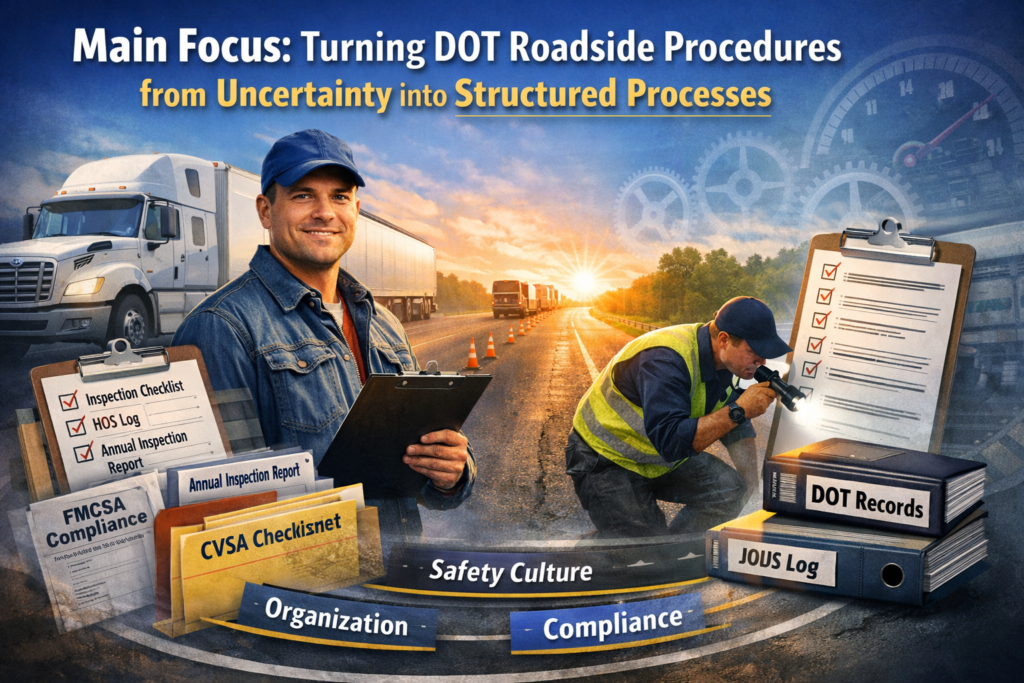
DOT inspection are no longer unpredictable events. With the right DOT inspection templates, they turn into aguas flowing in structured forms not confrontational stress.
Templates are neither a substitute for exemplary driving nor sincere maintenance; rather, they are a record of it. In DOT inspections, what can be checked quickly is as much as what is really done.
Drivers and fleets switch roadside inspection to own checkpoints through the organization of DOT records, FMCSA paperwork alignment, and adaptation to CVSA inspection styles.
The culmination of DOT inspection not just depends on the provision of documents being in order. It also, first and foremost, leads to the instilling of a culture of safety, professionalism, and consistency on the road.
HR: Decode DOT Inspection Files & Download the Forms
Which is the essential DOT paperwork that drivers have to always prepare before an inspection?
The essential DOT paperwork includes a valid driver’s license, medical certificate, vehicle registration, proof of insurance, inspection reports, and current hours of service logs. Organizing these documents with the help of templates allows inspectors to quickly and easily verify compliance without adding time to the inspection.
In what ways do hours of service logs be of help in a DOT inspection?
The inspectors usually start their review with the hours of service logs. Logs that are clear and concise along with appropriate annotations are evidence of compliance thus causing fewer follow-up questions. Templates facilitate daily review of entries which in turn helps to identify issues that will not pop up during roadside inspection.
Why are the annual inspection standards very crucial in the course of the commercial vehicle checks?
The annual inspection stipulations show that for a prolonged period of time the vehicle has met federal safety standards not just on the specific day of the inspection. A summary table that is visually appealing has inspection dates, certificates, and expirations, which is an efficient way for inspectors to verify compliance without going through maintenance files.
How does a brake system inspection template be practical in D.O.T checks?
A brake system inspection template will record the regular check on braking components and adjustment. Almost always brake issues are the prime focus area during inspections, and a positive statement of safety shows that the possible fault is foreseen and won’t be an issue during inspection.
What is an air brake system check in particular when can it help the DOT compliance?
An air brake system check is a must for vehicles that are air brake equipped and it is significantly crucial when Level 1 inspections are being performed. A specific template which addresses air pressure build-up, leak tests, and component condition aids inspectors in confirming the proper evaluation and maintenance of the system in line with annual inspection requirements.
No responses yet